Showing posts with label kids health. Show all posts

Tuesday, 8 November 2016

Should we keep our infant's environment totally sterile?

Babies and germs, a good mix?


When I was a kid, my mother used to say “well, you have to eat a bucket of dirt and a barrel of bugs before you die so I guess you’ll live if you get dirty” . What she meant was a child will inevitably get dirty, be exposed to germs, and be around others who are sick. You can’t protect them from everything, and you probably shouldn’t.
I already hear everyone all around the internet screaming about this one; however, take a moment to hear me out. When a child is born, they are leaving a relatively sterile environment and entering a world filled with bacteria, viruses, and germs of every form. Their immune system has to be strong enough to quickly build and fight such exposure within their first few hours of life. In fact, an infant’s system has billions of immunological cells within their body so they can fight the different microorganisms that they are so suddenly exposed to in our less than sterile world. (In fact their immune systems are capable of fighting 10,000 germs at one time when they are born and as they develop. Infants currently receive five with each immunization.)
Then, before they even have their first drink of milk (from whatever source) they have already received vaccines from the nurses who attend the newborn babies. Then the milk (breast milk, is of course the best source) will provide another means of fighting the microorganisms that always seem to be floating around no matter how hard we try.

Should it be sterile?

"Hi, I like to invade adults, but young kids terrify me because they can fight me better than adults."

Now, with all of this in mind, should we keep them in as sterile an environment as we can until they are older? I don’t believe so. We should keep them in a clean environment, of course, but I think that today’s society goes too far. For instance: I have seen commercials showing parents of toddlers how to bleach their child’s toys daily to keep them germ free. Cleaners are now available to 'clean the germs away from' the child’s high chair, the refrigerator, the stove, the sink, the floors and even the dishes that the child uses.
I have seen parents panic if their child gets near someone who is coughing or sneezing, even if that person is taking precautions. I have seen doctor’s offices, vet's offices, vision specialists, etc. remove the toys and books from their waiting rooms. I have seen people panic if their child touches a table in a fast food restaurant; and you wouldn’t believe the panic if they fall, sit, or touch the floor in any way! Keep things clean, yes, but is there a point when we have gone overboard? Before you start sending me death threats or something, let me explain why I ask that question. Who knows, you might actually begin to agree with me.

To start with, let's try to break things down a bit.

The child has been born with an immense immune system capable of taking on 10,000 different types of germs at one sitting. The child needs these germs to help build their immune system so they can fight illness. Once the child begins receiving nourishment, their immune system can begin to build its own vaccines to normal everyday bacteria, viruses, and germs so their body can fight against them. Does this mean the child might get sick? Of course there is always the possibility; in fact it is most likely, and preferable. Mild illness is normal and natural for an infant and toddler. In fact it is necessary if the child is going to grow up strong and healthy.
Imagine the child who has been in a sterile environment all of their life. They turn 18 and go out into the world. Their immune system hasn’t developed any antibodies since infancy because they have been protected from all of the normal germs to which young children are exposed. Their immune system as an adult is possibly capable of fighting germs one by one; but they will be infected by several different types of germs all at once. In fact, the immune system of an adult has about 1/8th of the fighting capability of an infant or toddler. What do you think is going to happen to that new adult? I’d hate to find out, but I’m sure it will be BAD.

To germ or not to germ (sorry, just joking)

 
Germ
Possible Result
Child
slightly ill
child-stronger
Adult
very ill
adult-still very ill


Now that I have broken it down a bit, what is next?

Now I am not saying let the child play in the toilet (NO WAY!) and I’m not saying let the child crawl around in stagnant water (UGH!). I’m not saying the child should play with raw chicken (DISGUSTING) and I’m not saying the child should be allowed to eat rotten food (UMPH).
Common sense tells us that we need to keep our children away from the worst of the germs. These are things that even adults can't fight. But to sterilize their beds, their toys, their clothes, their seats, the door knobs they touch, the rugs they walk on, the table where they draw and color, even their food is a bit far out. Let the kid be a kid. Let them get dirty once in awhile, they are washable. Let them be exposed to the small germs that populate the house. It won’t hurt them; in fact it will PROBABLY make them healthier in the process. (And yes, children are usually sicker than adults because they haven't been exposed to as many viruses and germs as an adult has been and so they do not yet have any immunity to them.)
HOW will it make them healthier? Well, when a child is exposed to mild germs and bacteria their body immediately begins producing antibodies to fight them. In the process, just like when they receive a vaccine, they become immune to the germs and bacteria to which they are exposed. Since their immune system is so much stronger than an adult or even a young teenager, they should be exposed to the mild germs as an infant and/or toddler to allow their body to build a defense against them before their immune system slows down its fighting abilities. I don't mean that you should purposely allow your child to play in the trash, I mean don't sanitize every little thing your child might possibly touch!
Children can fight the battle with germs better than adults can! They have a stronger immune system!

The mommy instinct!

I hear that dreaded sentence coming from so many mommy lips: “But then they’ll get sick!” Your child might get sick to some extent, (and probably will since they don't yet have the antibodies to fight the bacteria) but that just means the bacteria, virus, or germ was a strong one and it is taking a bit longer for your child to build up an immunity to it. Will they become deathly ill from mild exposure? NO-NO-NO! Most infants and toddlers are healthy enough to fight off the usual cold, sniffles, ear infections and such that are so common when children are young. There is always the exception, but we all know when our children are generally healthy and when they are not.

In between---the battle ground.

Keeping them in a bubble to prevent them from ever getting ill will prevent them from developing an immune system that can fight illnesses when they become adults.
There needs to be a happy medium when it comes to our children. We don’t want to shove them into every situation that exposes them to a bacteria, but we don’t want to over-protect them from it either. What we need to do is find that middle point, the one that says “OK, that isn't too much ,” or “That’s not too bad ”. I know it’s hard, but we all have to find that point, for our children’s sake. We want them to be strong, healthy and ready for any challenge, including the challenge of illness.
We really can’t protect our children for their entire lives. We can’t keep them in a bubble inside a well-guarded safe until they die of old age (as mommies all over the world would like to be able to do). We can, however, do our very best for them. One way is to keep them as healthy as possible. Another is to allow their natural defenses to come to the forefront and fight the battles that will need to be fought at one time or another during their lifetime. Why not allow the battle to be fought when your child’s immune system is strong enough to easily win!

The conclusion...........

If you keep your child clean, well fed, and safe from any dangerous environments, but don't carry it too far, your child will grow up to be strong and healthy. A cold now and then is no big deal. A sneeze or three doesn't mean they are to be bedridden for weeks. An ear-infection doesn't mean you have been a neglectful parent. It is not bad to let them make a mud pie or splash in the mud puddle out-back (unless you know there is something harmful like a dead animal in it). So let them get out and get a bit dirty. Let them play. Let them be exposed to a minor germ now and then. Allow your child to be a child so that their natural disease fighting abilities can create those all important antibodies that will keep them illness-free in their later years. Keep the disinfectant for when it is really needed.
Continue reading Should we keep our infant's environment totally sterile?

Ten unique things we can do to keep our kids healthy.

We hear it all the time, to keep your kids healthy they should eat right, exercise, and have shots up to date.


Yes, we all know the drill. But kids, ya gotta love them, are not just a cute face that follows you around and listens to your every word. No, sadly, kids are curious. They want to know why that thing on the stove turns red or orange. They want to know why you smell good after spraying that bottle on yourself. They want to know what that awful smell is and why it smells bad. There is so much more, that I could fill a whole hub with just the list. However, I will end here. I do, however, wish to note that kids are also extremely intelligent. They mimic an adults every move, and they throw our own words back at us. Rotten brats, oops, I mean, silly kids.

Children get distracted.

Children tend to forget what they are, and are not, supposed to do because they are so interested in what is going on around them. For instance, that tiny little sparkly thing under the couch looks real interesting………. So when that little youngster of yours begins to go quiet (warning, warning, red flag, red flag), you might want to check and see what the little angel has gotten into. No matter how much we clean and “child proof” our homes, they always manage to find the one thing we missed. I wonder how they do that.

Children learn what they see, not what we tell them.

Spend time with them while showing them how good we are at keeping safe and healthy. Our children learn more from our examples than from our words. No matter how much we say “no, no, no”, if we do, do, do, that is what the child will see, and inevitably, do. We can't believe that they won't see us do things because they have big ears and big eyes. Take the time to clean up your act (if you need to) so that you can teach your child the things you want your child to learn. Remember that the saying "do as I say not as I do" doesn't work.

Eating well is hard to teach unless you begin early.

Introduce the child to fruits and vegetables at an early age. (I always use the idea of “if you try a little and don’t like it, you don’t have to eat the rest.” They generally eat it, especially if it is a vegetable that I like.) This will help them develop a healthy eating habit. Also, limit how many sugary treats and snacks are in the house. This helps teach the child that a little goes a long way. (And no fair hiding and munching when the child can’t see you, remember the do as I do rule.)
Also, when throwing a party for the child, try asking everyone to bring a dish. That will mean they will be taking home the left-overs and there will be less for your child (and you) to snack on later.

Brushing their teeth


Teach the child to brush their teeth early. Early childhood tooth decay can cause a variety of health and mental issues later on in life. Children with poor tooth health often suffer pain, tooth loss, infections which can cause developmental problems and/or illness, and eating disorders. Their organs may not develop correctly due to bacteria or incorrect eating habits because their teeth hurt. They may have trouble concentrating in school and may have trouble socializing because of their teeth. When baby teeth develop decay and have to be removed, adult teeth may not come in correctly as a result.
You could give them fun brushes to use and a timer set for 2 minutes. Note: avoid giving a child a sugary bottle at bedtime because the sugar stays in their mouths for the majority of the night and can, and will, affect their first teeth.

Keep them to a schedule

Sounds like the army, right? But, this actually helps them develop a balance of work and play time. A set schedule also helps to get the child to sleep on time giving them the necessary amount of sleep required for their development (and making it much easier for you at night). It also helps the child to eat better and snack less if meals are at a set time. There will be less trouble with getting them off to school, getting homework done, and getting their rooms clean (OK, I was exaggerating with that last one, but we can hope.) Children on a schedule get better grades, adjust faster to new situations, and handle adult stress better. I am not suggesting that you use a schedule so tight that nothing ever changes, but a regular schedule does make a difference.
While you are keeping them on that schedule, try to be consistent in your discipline techniques. If you give them a time-out each time they they argue back, rather than yell several times and then things get real rough, your child will understand that they will get a time-out if they argue back. This will prevent them from doing so except in extreme cases--at which time you might want to listen to them rather than punish them.

Peer pressure can be tough on kids

Your child may be convinced by their peers to wear certain things that show their position in life. For instance, if yellow sneakers with flashing lights are the newest thing, your child might be bullied into asking for a pair. Then, they might be wary when those sneakers become tight because they know you won't buy them a new yellow flashing set.

Check clothes and shoes often for tightness or wear and tear

Children often seem to grow overnight and their clothes get tight causing irritation, bruises, and sores. Tight clothes can also cause infections if not addressed. Often children get so caught up in their playing, that they forget to say something about their shoes hurting their toes or their pants rubbing their legs. Also, they might not tell you about it because it is the latest thing to have or it is their favorite item. Try to get the clothes slightly loose so the child has a bit of ‘breathing’ room (it’s a chance, but, well, if you are a parent, you know how quick they grow).

Strange animals


Teach your children not to approach strange animals. Strange animals may have health issues, parasites that may affect children if they touch them, or they may bite or scratch the child causing serious injury. Animals, especially sick or injured ones, will attack in order to protect themselves. It is instinct. Just like sniffing the air for an enemy or knowing how to get home. Just like a stranger, if children don’t know an animal, they shouldn’t approach it. And make sure they know to ask before approaching an animal that is attended by someone. Even animals with their owners might bite if approached without warning. Especially since children are fast and loud. This will frighten the animal even more. Wild animals should be avoided at all costs!

Lunch trading

When you pack a lunch for your child, you know the food is good and safe for your child to eat. If they trade their food, they could get something they are allergic to, for instance, or they might get a sugary treat that could make them sick. Children should never trade their lunches. A good way to keep your child from trading their lunch, is to let them choose what goes into their lunch each day. Have a variety of fruits, healthy snack items, and flavored milks as well as their favorite sandwich fixings.
Sometimes it makes them feel more grown up if you give them things like mayo packets so they can put on their own mayo at lunch. Be sure to include a spoon (knives are dangerous even if they aren’t sharp) to spread the mayo and a bag to seal the spoon in so they don’t get mayo all over their lunch box when they bring the spoon home. Or, you can give them a plastic spoon that they can throw away. Getting their lunch together the night before means they will have a healthy lunch rather than something thrown together as they are racing out the door to catch the bus.

Avoid the germ war

Teach your child to wash their hands often and properly to avoid germs that may be present. All children get sick because their immune system is still trying to build itself up. The younger the child, the weaker the immune system. The fighting of the germs children are exposed to might make them a bit sick. No big deal, right? We don’t really want to avoid the common germs because they do help our children’s immune systems to develop.
But what about other cases like when the child falls on the ground (imagine what could be there for them to put their hands into) or empties the trash into a dirty trash bin? Those germs are stronger than the common ones and they can cause your child to become seriously ill. If your child regularly washes their hands (especially after these events), there will be less of a chance the child will become seriously ill. They may get a bit sick, but their bodies can fight that. They can’t fight the serious bacteria that grows and mutates into something stronger and stronger as we try to fight it. By teaching our children to properly wash their hands, and to wash them often, we teach them to wash away those dangerous germs causing less exposure and less of a chance of them getting seriously ill.

Gaming systems are not babysitters

Restrict the use of your child's gaming systems. Involve them more in the things to be done with the family. Gaming systems are great for teaching children dexterity, hand/eye coordination, and brain strength, but too much can be dangerous and/or addictive. By involving them in doing things for/or with the family, you get them their much needed exercise but you also give them a sense of accomplishment. Assign them each a simple chore to be done each day, or have them help with dinner.
You would be surprised how much little hands can help out when you get creative. I have put my young ones to work setting the table, stirring items on low heat, mixing eggs into a batter, or even drying the plastic items when I did dishes. It gives them a sense of involvement, a sense of accomplishment and a sense of being grown-up. (Oh yes, make sure everyone in the house compliments them on a task well done when they brag about their endeavors.) The best part is: once they get used to helping out when young, it is easier to get them to help when they are older. And don't let the boys off the hook if you believe that some tasks are for girls only. Teaching a boy to cook, do dishes and wash clothes will be excellent for when he is on his own and needs to do these things for himself.

Love, love, love

As children grow, of course, you will have to get creative with your teachings; however, I think the majority of these will be lessons learned for a life-time of healthy choices and observations. Oh yes, one last thing. Love your kids unconditionally. No matter what they do, say, or break, they are still your kids and they love you more than you will ever know. Show them that love back, as often as you can, and training, teaching, guiding, and helping will be much easier. Besides, it is so much fun to wrap that cute little angel in your arms and hug and kiss them, isn’t it (especially when they are ‘all grown up’ and don’t do that mushy stuff anymore, right moms?)
I know a lot of what I have here is common sense, but sometimes it’s easier to keep up with such things if they are written down for us to see. I hope I have given at least one person a helping hand in keeping their children healthy.
Continue reading Ten unique things we can do to keep our kids healthy.

Signs of Multiple Sclerosis in Children


What is multiple sclerosis (MS) ?

MS is a condition that occurs in the central nervous system. The coating around nerve fibers known as myelin is damaged by the body’s immune system, which mistakes myelin for a foreign body and attacks it. Nerve fibers help the brain and the rest of the body to communicate. When they are stripped of myelin, lesions or plaques would form that disrupt the messages travelling along nerve fibers partially or completely. The messages are distorted and cannot get through at all. The actual nerve fibers may also become damaged.
The type of symptoms that appear vary, depending on which part of the central nervous system is affected and what function the damaged nerve had. MS is usually diagnosed between the ages of 20 to 40, and affects approximately three times as many women as men. There is no cure for this condition but there are treatments that can help manage the symptoms.

MS in children

MS is usually an adult disease, but the number of children and adolescents that are being diagnosed with MS is on the rise. Research suggests that two to five percent of all people with MS experience MS symptoms before the age of 18.
Neurologists think that many children have MS but are not diagnosed. Medical practitioners find diagnosing MS in children much more challenging than in adults because many childhood disorders have similar characteristics and symptoms. Pediatricians may not be familiar with MS and do not expect to see it in children.

Symptoms of MS in children

  • Difficulty walking
  • Physical weakness and lethargy
  • Poor body co-ordination
  • Tremors
  • Problems with bladder control
  • Muscle spasms
  • Sensory changes, tingling, or numbness
  • Changes in vision
  • Tremors
  • Seizures (not typical in adults with MS)
MS symptoms come and go and can be mild or severe. MS symptoms vary from person to person. The time the symptoms last also vary. Some symptoms may linger after an attack such as muscle stiffness, tiredness, numbness or tingling, and depression. Infections or fevers may temporarily worsen MS symptoms, but will lessen once the infection or fever subsides. Adults with MS do not typically have symptoms such as lethargy or seizures.
Multiple sclerosis may appear differently in children than it does in adults. There may be temporary neurological symptoms in children such as coma, delirium, fever, headache, lethargy, seizures, and stiff neck. Children with MS will continue to have these symptoms and additional signs.
The severity and location of attacks vary. Episodes can last for days, weeks, or months, and alternate with periods of less or no symptoms. Attacks may be triggered or worsened by hot baths, fever, and stress. Patients may experience a period of remission, and then relapse. The disease sometimes becomes worse without a period of remission. Children often experience relapses more often than adults with early MS.
Scientists think that MS progresses more slowly in children than adults. People who being to have MS in childhood or adolescence can experience significant disabilities at an earlier age than adults with MS. Young people may also experience psychological and cognitive damage that will affect their self-image, academic performance, and relationships with others.
MS often affects the brain’s cognitive abilities, such as remembering to do things and remembering recent events. Many people with MS report they need more time and effort to recall a memory. People with MS find it difficult to concentrate for long periods of time. They also lose track of what they are doing if they are interrupted.
It is difficult for them to carry on a conversation or do several jobs at once when they are distracted by radio or TV. Making decisions and solving problems are also difficult. Children and youth will struggle in school to concentrate and complete tasks.

MS Diagnosis

Neurological exam: There are a number of tools that will be used to diagnose MS. A neurologist will ask a lot of questions about past symptoms and problems to identify the cause of the current symptoms. The neurologist will check for changes or weaknesses in leg or hand coordination, eye movements, balance, speech, sensation, or reflexes. A neurologist may suspect MS, but will not make a diagnosis until other test results confirm MS.
Magnetic Resonance Imaging (MRI): An MRI scanner is a painless procedure that uses a strong magnetic field to create a detailed image of the spinal cord and brain. MRIs can pinpoint the exact location and size of any lesions or damage.
Lumbar puncture: A lumbar puncture, also known as a spinal tap, involves inserting a needle into the space around the spinal cord while under a local anaesthetic. A small sample is taken of cerebrospinal fluid, the fluid that flows around the brain and spinal cord, and is tested for abnormalities. People with MS often have antibodies in the fluid.
Other tests: Other tests may be done such as blood tests to check for specific antibodies, and inner ear tests to check the patient’s balance.

Effect on the Family


Children with MS may react to their diagnosis with mood swings, depression, and anxiety. They can become aggressive. MS symptoms are unpredictable and can have a negative impact on communication and relationships.
The parents may focus a lot of attention to the child with MS, so the other siblings may feel jealous or resentful and express their feelings in bad behavior. It is important for families to have an open discussion about MS and share information about the nature of the condition.

Treatment

Some medications for MS are not approved for treatment of patients under the age of 18, however, there are some medications available that can reduce inflammation in the brain and spinal cord. In the U.S., the U.S. Food and Drug Administration have approved some self-injectable disease-modifying therapies in trials meant for adults that are also well tolerated and safe in children.
Medical professionals must monitor the patients closely. Physical and occupational therapy, and counseling can also help relieve symptoms.
Continue reading Signs of Multiple Sclerosis in Children
,

A Guide to Growth Plate Injuries and Fractures

What is a growth plate?

A growth plate (or "physis" in Greek) is the area from which your child's bone grows. Almost every bone in the body has at least one growth plate. The only bones which do not have a physis are bones that develop from membranes, such as most of the bones in the skull.
The physis is made up of cartilage cells and these cells replicate and grow in size. As they grow, they move the part of the bone above the physis (the epiphysis) away from the bone below (the metaphysis). As the cells mature, they die and are replaced by bone. Thus it seems as if the bone itself is growing. Eventually, the cartilage cells lose their ability to divide and are completely replaced by bone, a point known as "skeletal maturity." This happens in adolescence and is around 14 1/2 years for girls and 17 years for boys. Not every bone stops growing at the same time. For instance, the clavicle continues to grow in boys until about the age of 21 years. Even the bones in your foot and wrist (called "cuboid" bones) have a physis. In these bones the physis completely surrounds the bone.

How can growth plates be injured?

Growth plates can be injured by a number of mechanisms. The two most common are infections and fractures (a break in the bone that includes part or all of the growth plate). Infection can injure a growth plate especially in newborns, because there are blood vessels that go across the physis. These vessels are conduits that can allow bacteria to enter and destroy the cartilage cells. This is why infections in neonates (newborn babies) are so concerning. As the child gets older (about 1 year of age), those blood vessels disappear, and the physis becomes much more resistant to infection.
The other common mechanism is fracture. Fractures through the physis often occur in children because it is the weakest part of the bone. The particular bone and the amount of force that causes the fracture determine which bones are more at risk. For instance, the distal radius (wrist) is perhaps the most common growth plate injury in children, but rarely results in abnormal growth (or "growth arrest") because the amount of force required to fracture there is small. Most are from falls at standing height. Another growth plate frequently injured but rarely affected is the distal fibula (outside part of the ankle). Again, it is a small bone that is usually injured with minor force.
Other bones are much more prone to damage of the growth plate and may result in a growth arrest, either by healing with bone across the plate (a bar) or by simply injuring the growth cartilage cells themselves. An example of a growth plates with high risk of arrest is the distal femur (just above the knee). This growth plate is very wide and requires a considerable force to fracture.
Other causes of growth plate injury are listed in the following table.


Other causes of growth plate injuries

Injury
Thermal
Medication
Inflammatory
 
 
Burns
Chemotherapy
Juvenile Inflammatory Arthritis
 
 
Radiation
Vitamin A overdose


Types of growth plate fractures

Growth plate injuries are usually categorized by the parts of the bone involved and the direction of the fracture. The most commonly used classification is called the Salter-Harris classification. It breaks injuries down into 5 types.

Salter - Harris Classification

Type
Direction of the fracture
Unique Characteristics
I
Transversely across the physis, no injury to the bone on either side
 
II
A fracture that starts physis and exits in the metaphysis
The triangle of bone from the metaphysis is called the Thurstan-Holland fragment
III
A fracture that starts in the physis and exits in the epiphysis
The joint surface is involved and requires special attention to be sure it is aligned properly
IV
A fracture that crosses both the metaphysis and epiphysis
Again the joint surface is involved. This fracture has a higher risk of growth arrest.
V
A crush injury to the growthplate
This injury is only discovered in hindsight (after the growth arrest is recognized)


Growth plate injury of the ankle

Salter-Harris III fracture of the medial Malleolus (blue arrow) and Salter-Harris I fracture of the lateral Malleolus (red arrow)

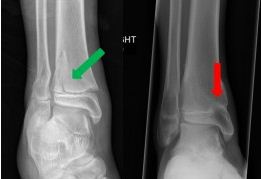
Ankle injury with growth arrest


Salter-Harris II fracture (green arrow) and resultant growth arrest with bar (red arrow) 6 months later. 

What can I do to avoid a growth arrest?

Talk to your physician. Most children with growth plate injuries should be treated by a pediatric orthopaedic surgeon. These are orthopaedic surgeons that specialize in children's injuries and other bone and joint problems, and know which injuries are really at risk and which are not. They can evaluate your child and determine the risks and advise you about the best type of treatment.
Ask your pediatrician or emergency room physician to refer you to a pediatric orthopaedic surgeon. A good place to find one is at your local Children's Hospital or you can locate one at POSNA.org.

How are growth plate injuries treated?
The best chance for normal growth after the healing of a fracture through the growth plate is getting the growth plate perfectly lined up (surgeons often refer to this as "anatomic alignment." This is no guarantee, however. Even if perfectly aligned, damage to the growth cells may have occurred at the time of injury. Your surgeon may recommend a closed reduction, in which the bone is pushed back into place and a cast is applied to hold it in that position. Sometimes they will recommend an open reduction with internal fixation (referred to as "ORIF"). This is much more common when the fracture involves the joint surface (such as a type III or type IV), or in bones that require a significant force to fracture (like the distal femur).
However, some fractures such as some of those in the distal radius will do just fine even if not perfectly lined up. That is why having the expertise of a pediatric orthopaedic surgeon is so important. He can guide you regarding appropriate treatment.


Continue reading A Guide to Growth Plate Injuries and Fractures

ads